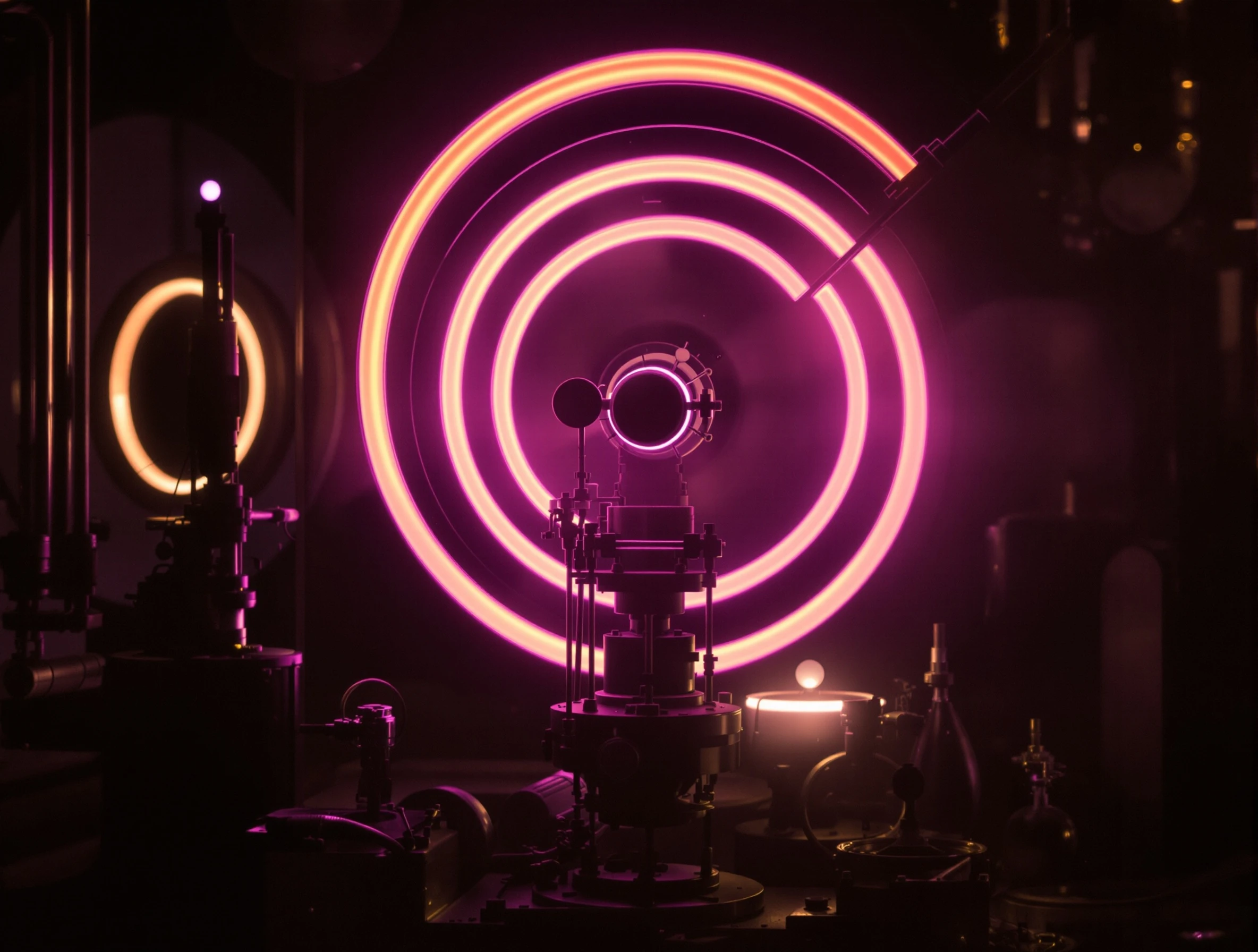
Every instrument we build carries a debt, and one of the oldest is owed to Georges Lakhovsky. He was not the first to think about high-frequency fields and the body — Tesla had opened that door decades earlier — but he asked a particular question that changed the shape of everything that came after. If a living organism has its own rhythms, he wondered, what kind of field would give it the widest possible chance of finding a frequency it recognized? His answer was not a single, perfect tone. It was many at once.
The reasoning behind the many
Lakhovsky's premise, laid out most fully in his 1935 book "The Secret of Life," was that living cells behave, in some sense, like tiny oscillating circuits — each with its own tendency to vibrate. He wrote in the language of his era, and we present his ideas here as history rather than as settled science. But the logic he followed has a clean elegance that still holds our attention. A single frequency, however carefully chosen, might miss. It might pass a cell by, never quite matching. A field crowded with frequencies, by contrast, offered many chances at once — a spread wide enough that something living might find a rhythm to answer.
This is the idea he called resonance, and it led him to build the Multiple Wave Oscillator in 1925. Rather than emit one note, the instrument was designed to fill the air with a broad band of frequencies and their harmonics, so that the field itself became a kind of chord rather than a single string. The name is almost a thesis statement: multiple wave. More was, in his reasoning, better — not louder, but richer.
The more frequencies a field carries, the better its chance of meeting a living thing.
Why he charged the argon
The detail that reaches us most directly is what Lakhovsky did with his antenna rings. He did not leave them as bare conductors. He charged argon within them — a inert gas, sealed and excited into a glow — so that the rings themselves became part of the resonating system. The gas gave the field a richer harmonic content than metal alone would carry, adding overtones to the fundamental, thickening the chord.
It is a small decision with a long shadow. When we speak of inert gases in our own work — of argon, krypton, xenon, and neon sealed in glass and lifted into plasma by a Tesla coil — we are, whether we name him or not, continuing a line of thought Lakhovsky drew nearly a century ago. The gases are not decoration. They are the reason the field has depth. Excited into plasma, a inert gas does not hum on one frequency; it sings across a band, and each gas sings differently. That difference is precisely what Lakhovsky was after.
What we inherited, and what we changed
We are careful not to overclaim on his behalf. Lakhovsky worked in the 1920s and 1930s, in a scientific culture that made claims we would not make today, and the instruments of that time were not held to the standards we now expect. Our instruments are research instruments; they are not medical devices, and we make no claims about what they do to the body. What we take from Lakhovsky is not a promise but a principle: that a field with many frequencies has a wider reach than a field with few.
That principle survived the decades because it kept proving useful in the building. The early units we made carried only three tubes. Over years of listening to what the field actually did — of moving tubes and hearing the harmonic content shift — that number grew to twelve, each holding its inert gas, each contributing its voice to a chord no single tube could produce. Lakhovsky would have recognized the reasoning immediately. More frequencies, more overtones, a richer field. He charged argon in his rings for the same reason we seal it in ours: because a living thing, if it is going to find a rhythm to answer, deserves a field wide enough to offer one.
Multidimensional Technologies makes no medical claims. These instruments are not FDA-cleared medical devices and do not diagnose, treat, cure, or prevent any disease.