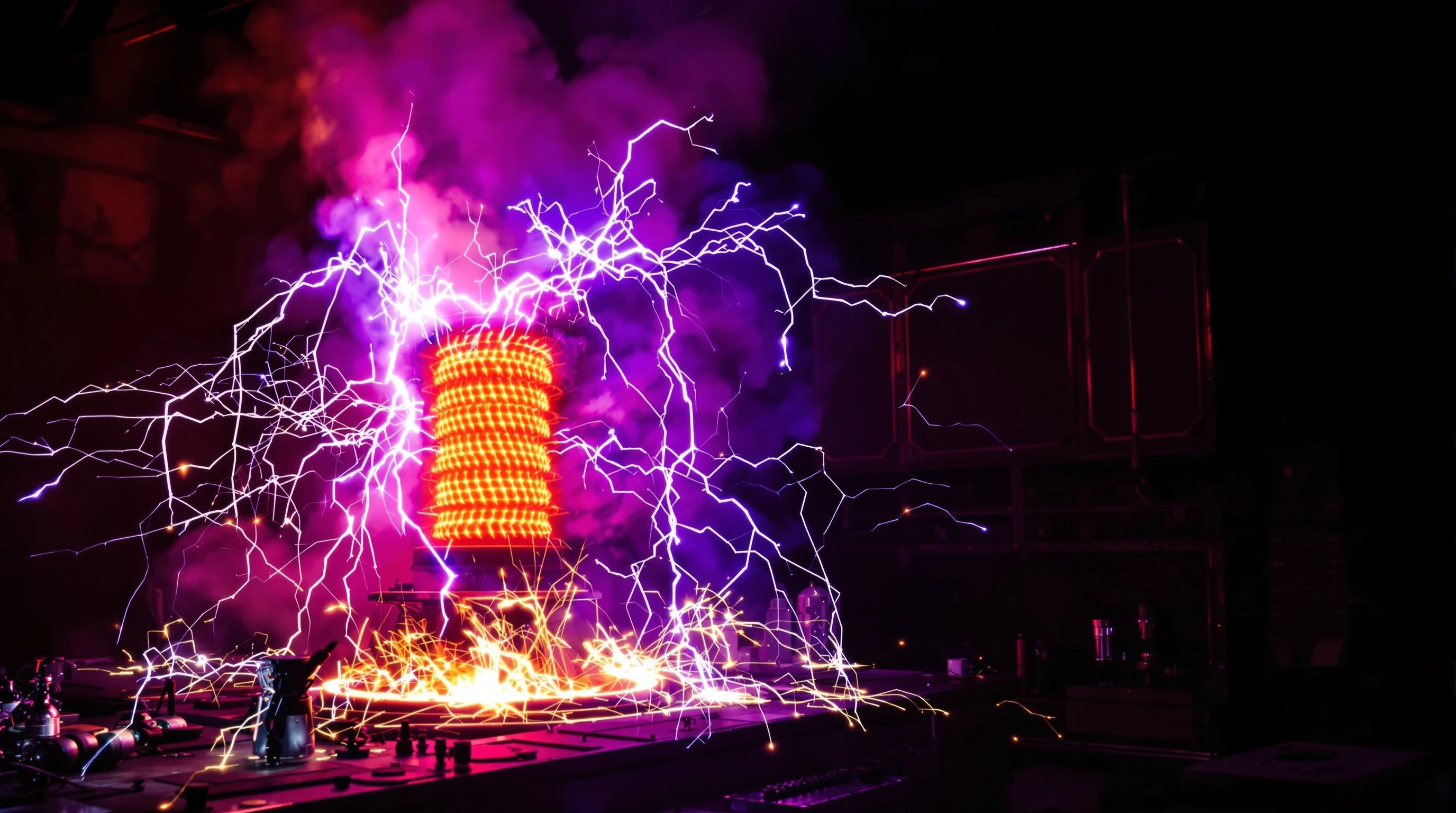
It is easy to forget that Nikola Tesla, father of alternating current, of radio, of remote control — holder of nearly three hundred patents — spent a portion of his most inventive years thinking about the body. Not as a physician, and not with the caution a physician would bring, but as an electrical engineer fascinated by what his high-frequency currents did when they passed near living tissue. The record he left is a historical one, written in the language and the confidence of his era, and we offer it here as history — not as medical fact, and not as anything we endorse or repeat as a claim.
The 1891 lectures and the strange comfort of the current
Tesla's public fascination with high-frequency phenomena announced itself in 1891, in the famous demonstrations where he passed currents of great frequency and voltage across his own body and lit lamps in his bare hands without apparent harm. Part of the wonder, for his audiences, was that these currents did not behave like the low-frequency electricity that could kill a man. At high frequency, Tesla observed, the current seemed to travel along the surface rather than through the vital organs, and its passage produced not pain but a curious warmth.
He remarked more than once on that warmth — on a sense of well-being and stimulation that accompanied his experiments. We report this as his account, from his time. Tesla was describing his own sensations in an age before controlled trials, before the regulatory frameworks that govern medical claims today. What matters, for the line we trace, is that a man of his stature took seriously the idea that high-frequency energy and the human body had something to say to one another.
The 1898 paper
In 1898, Tesla brought these thoughts before a professional audience directly, in a paper titled "High Frequency Oscillators for Electro-Therapeutic and Other Purposes," presented to the American Electro-Therapeutic Association. The title alone tells you how openly the subject was discussed in his day. Physicians of the period experimented with high-frequency currents in earnest, and Tesla — the man who had done more than anyone to understand those currents — was writing to them as a peer, offering his oscillators as instruments for their inquiries.
The claims made in that era were the claims of that era. Electro-therapeutics was a recognized field in the 1890s, pursued with genuine seriousness and, by today's standards, insufficient evidence. We do not endorse the historical clinical assertions, and we would not make them ourselves. But the paper is real, the association was real, and the ambition behind them is part of the honest lineage of the coil. Tesla did not think of his high-frequency apparatus as belonging only to the laboratory or the power station. He thought some of it might belong near the body, and he said so, in print, to the doctors of his day.
We inherit the coil from Tesla. We do not inherit the medical claims of his century.
What began, and what it became
From those lectures and that paper, a century of exploration followed — some of it rigorous, much of it not, and a great deal of it made by people who never met one another but shared Tesla's intuition that high-frequency fields and living things were worth studying together. Georges Lakhovsky pursued it in the 1920s with his Multiple Wave Oscillator. Later, Fritz-Albert Popp would open a different line of inquiry entirely, describing in the 1970s the faint light he called biophotons, emitted by living cells. The thread connecting them is not a shared conclusion. It is a shared question, and Tesla was among the first to ask it out loud.
We inherit the coil from Tesla — the air core resonant transformer at the heart of every instrument we build. We do not inherit the medical claims of his century, and we are careful to say so. Our instruments are research instruments. They are not FDA-cleared, and they do not diagnose, treat, cure, or prevent any disease. What we take from Tesla is the coil itself and the spirit of open inquiry that surrounded it — the willingness to build an instrument, to observe honestly, and to let others describe in their own words what they find.
That is the tradition, told truthfully. A brilliant man, more than a century ago, stood before a room of physicians and described what his currents seemed to do. He was working at the edge of what his era could verify. We build in the light of his coil, and we leave his claims where they belong — in his time, as history.
Multidimensional Technologies makes no medical claims. These instruments are not FDA-cleared medical devices and do not diagnose, treat, cure, or prevent any disease.