Practitioners often tell us the instrument is only half of a session; the room is the other half. We agree, and over the years we have gathered enough practitioner notes to offer some plain, practical guidance. None of this is doctrine. It is what experienced hands tend to arrive at, passed along so you can arrive there faster.
Light and Placement
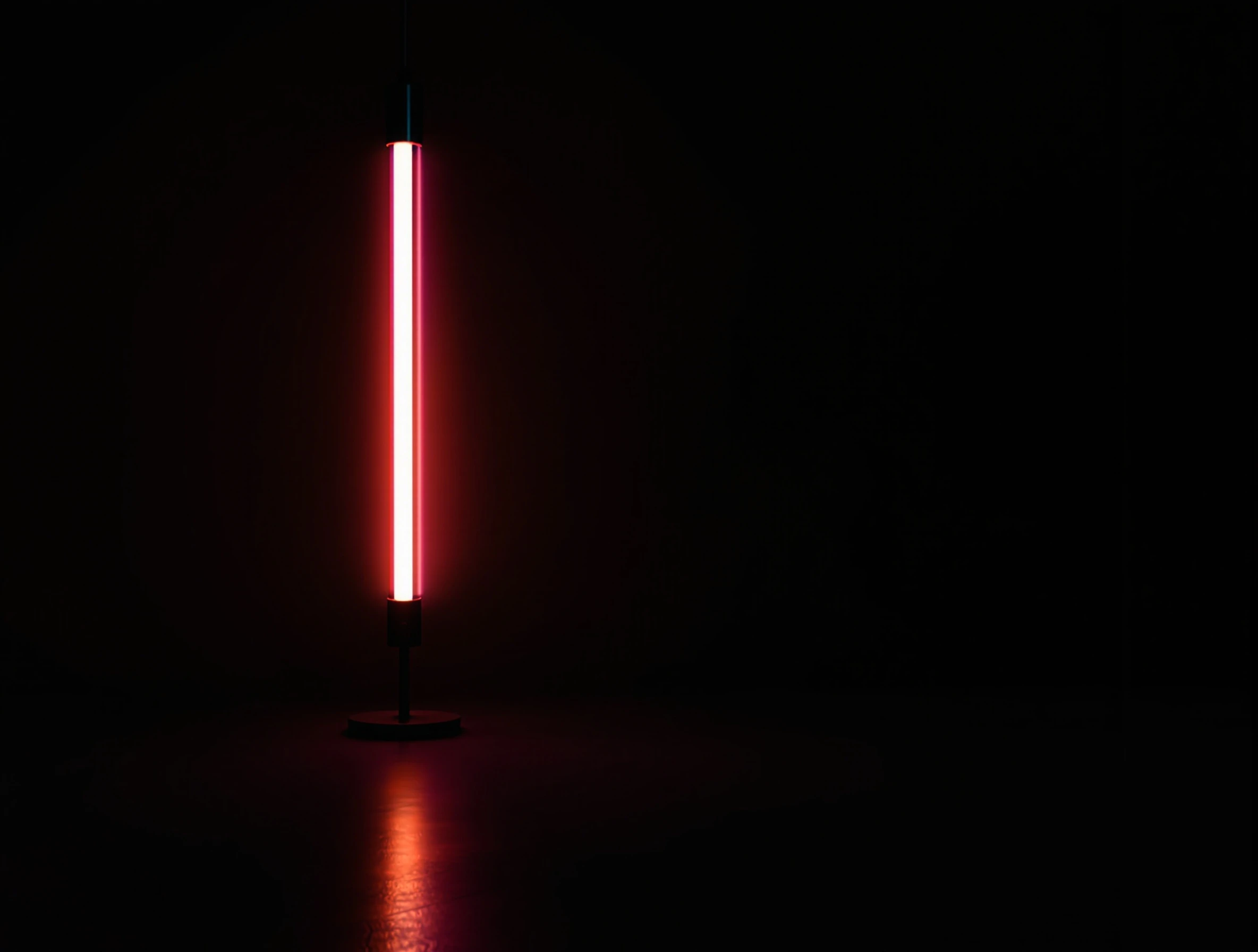
The instrument makes its own light, and the room should defer to it. Keep ambient light low and warm — enough to move safely, not enough to compete with the plasma. Practitioners generally place the instrument so the tall center quartz tube is clearly visible from where the explorer sits, aligned roughly with their seated height, base of spine to crown. Give it a solid, level surface and a little space around it; a crowded table pulls the eye toward clutter and away from the column.
The instrument is only half of a session; the room is the other half.
Avoid mirrors directly opposite the instrument. They double the light in a way most people find distracting rather than expansive. A plain wall behind it, matte and dark, tends to let the color read cleanly.
Seating and Distance
Comfort is not a luxury here; it is the whole point. An explorer who is fidgeting or bracing will spend the session managing the chair instead of resting in the field. Choose seating that supports an upright but relaxed posture — a chair with a real back, or a firm cushion for those who prefer the floor. Practitioners commonly seat the explorer a few feet from the instrument, close enough to be plainly within the field and far enough that the eye can take in the whole Carousel without strain. Let the explorer adjust their own distance; the right spot is usually the one they choose.
Silence and Sound
The instrument has a hum of its own, and most practitioners let it be the only sound in the room. Silence is not emptiness; it is the frame that lets people notice what they came to notice. If you use music, keep it beneath speech, ambient and without a strong pulse — anything with a beat tends to organize attention and pull people out of the settling that observers describe. Many practitioners prefer no music at all. Turn phones off, not to silent. A single buzz can end a session that took ten minutes to arrive.
Timing and the Frame
Give the session a clear beginning and end. Practitioners often start with a minute of quiet before the instrument is running, and close with a minute or two of stillness after — time for the explorer to come back to the room at their own pace rather than standing straight up into the day. Fifteen minutes in the field is a common length for a first sitting; let the explorer's own report, not the clock alone, guide whether to lengthen it another time.
A Note on Promises
Prepare the room, and then step back from expectation. We ask practitioners to hold the same honesty we hold: the instrument is a research instrument, not a medical device, and it is not cleared to diagnose, treat, cure, or prevent anything. What you are preparing is not an outcome but a condition — a quiet, well-lit, undisturbed space in which an explorer can sit inside the field and notice, for themselves, whatever there is to notice. Set the room well, say little, and let the field and the person do the rest.
Multidimensional Technologies makes no medical claims. These instruments are not FDA-cleared medical devices and do not diagnose, treat, cure, or prevent any disease.