Every year the pressure arrives to modernize. Add a screen. Add a chip. Add a connection to a phone, a schedule, a cloud. We have listened to the argument for three decades and declined it every time, and we want to explain why the refusal is not stubbornness but design.
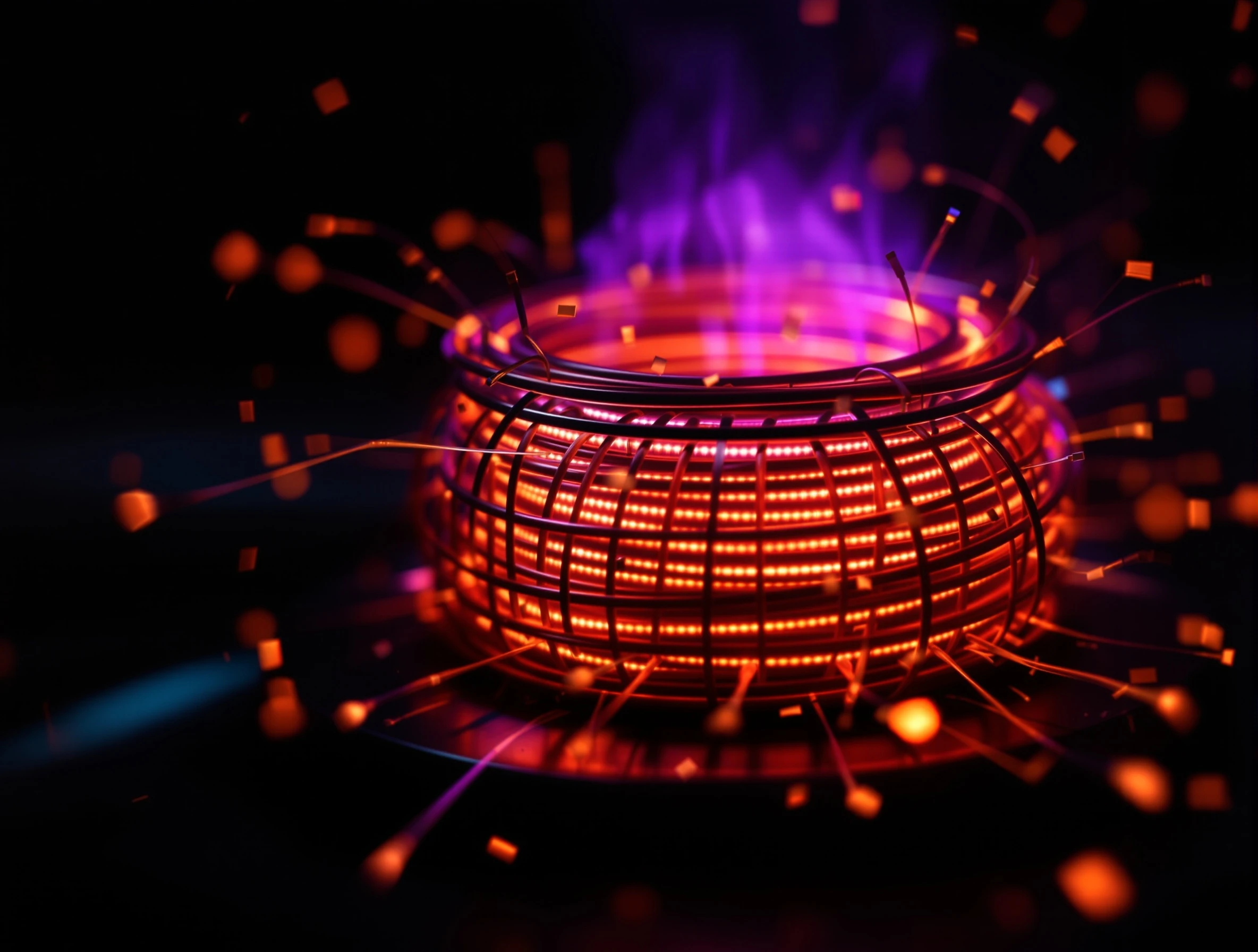
Our instrument is deliberately analog. There is no electronic spark gap, no wireless radio, no firmware waiting to be patched. An Air Core Resonant Transformer excites sealed inert gases — argon, krypton, xenon, neon — into plasma, and the field that results is shaped by physics, not by code. We think this matters more than it first appears.
The Harmonics the Digital Versions Lose
A resonant transformer does not produce a single clean tone. It produces a fundamental and a family of harmonics above it — a rich, layered field that rings the way a struck bell rings, with overtones the ear does not name but the body seems to register. This is the part the digital reproductions tend to lose.
When a spark gap is replaced by a solid-state switch, the waveform is cleaned up. Cleaned up sounds like an improvement. But cleaning a waveform means clipping its edges, and the edges are where the harmonics live. What you gain in efficiency you spend in complexity. Observers who have sat with both often describe the analog field as fuller, though we offer that only as their account, not as a measurement. What we can say plainly is that the physics of the analog design preserves a spectral richness the switched versions discard by definition.
Nothing to Update Is a Feature
There is a quieter argument, and for many owners it is the decisive one. An instrument with firmware is an instrument with an expiration date. It waits on a company to keep writing software, on a protocol to stay supported, on a server somewhere to stay alive. When those things end — and they always end — the object on the table becomes a paperweight with a good story.
An instrument with firmware is an instrument with an expiration date.
Ours has nothing to update because there is nothing to update. It is copper, glass, quartz, and sealed gas. The inert gases are inert precisely because they do not react; a sealed tube can hold its plasma for decades. In more than twenty-five years, fewer than a dozen of our instruments have ever come back — if even that. They are hand-built, and they are built to outlast the people who make them.
Analog as a Discipline
We are aware that "analog" has become a marketing word, a way to sell nostalgia. That is not our meaning. For us it is a discipline: a commitment to a design whose behavior is fully determined by its materials, that answers to no network, that cannot be reached or altered from outside the room it stands in. There is a kind of trust that only an object like this can earn. You know exactly what it is, because it is only ever what it is.
Tesla worked this way in 1891, chasing high-frequency energy with copper and glass and no chip in sight. We are not restoring an antique; we are continuing a line of thinking that never needed improving. Less, here, was always more. The instrument works for decades for the simplest reason available: there is nothing in it to break that a season of weather and a patient hand cannot outlast.
Multidimensional Technologies makes no medical claims. These instruments are not FDA-cleared medical devices and do not diagnose, treat, cure, or prevent any disease.